
On the evening of Tuesday, May 8, the Ceará Events Center hosted the awards ceremony for the O Setor Elétrico Award for Electrical Installation Quality (OSE 2018), promoted by O Setor Elétrico magazine, which aims to publicize and honor good project practices that promote increasingly sustainable and efficient solutions for Brazilian installations.
The award categories included:
- Industrial and commercial electrical installations
- Renewable energy
- Research & Development
- Lighting design project
- Technological innovation
- OSE 2018 project
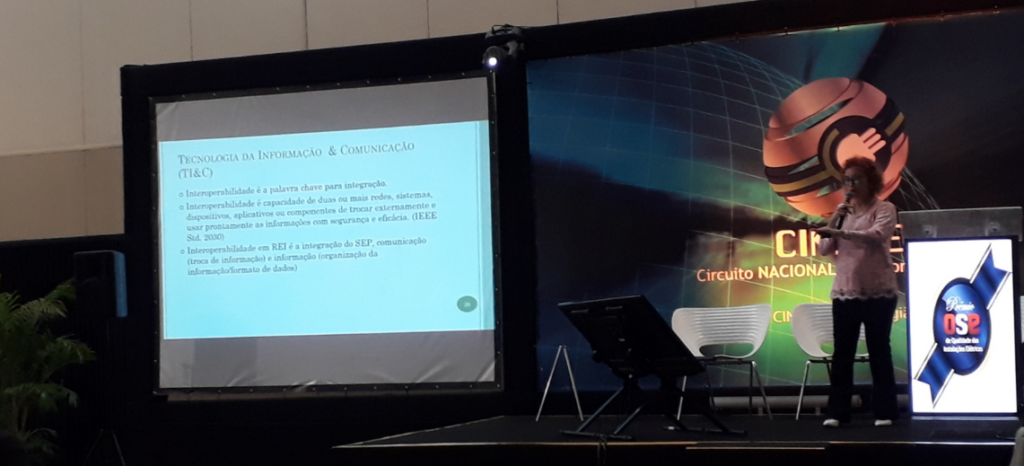
The awards ceremony was attended by numerous professionals and authorities linked to Ceará’s electrical energy sector, and featured professor Ruth Leão, founder of the Smart Electrical Grids Group (GREI) at UFC, as the opening keynote speaker. In her talk, titled “Advances in Electrical Distribution Grids with Distributed Energy Resources,” Professor Ruth highlighted the main trends in electrical distribution in light of smart grids, emphasizing topics such as distributed energy resources, cloud computing, the Internet of Things (IoT), blockchain, big data, demand response, microgrids, smart inverters, distribution system self-healing, automation, and smart protection systems.

That same night, GREI was also awarded the OSE 2018 prize in the Best Research and Development Project category, for the project titled “Design, development and implementation of an AC microgrid on a university campus with photovoltaic solar technology.”
The project covers the implementation of a microgrid on the Pici campus that integrates the following elements:
- Photovoltaic panel modules;
- Inverters that convert the direct current energy generated by the photovoltaic panels into alternating current, allowing it to be injected into the grid — four single-phase inverters in total, from manufacturers Fronius, SMA, and Refusol. One of the SMA inverters can operate in islanded mode, providing a voltage reference for the microgrid’s other inverters;
- Battery bank to store the electrical energy generated by the inverters;
- Automation panel to switch and control inverters and loads connected to the microgrid under different configurations, in order to simulate different operating conditions. A 35kVA 1:1 (380V:380V/220V) delta-star (Dyn1) transformer isolates the microgrid from the grid;
- Single-phase load bank to simulate different load conditions on the microgrid, including phase-unbalance conditions;
- Doubly-fed induction generator (DFIG) with a coupled induction motor to simulate a wind turbine coupled to the generator;
- SCADA system to monitor and control the microgrid’s elements;
- Power quality analyzer for data collection and analysis.

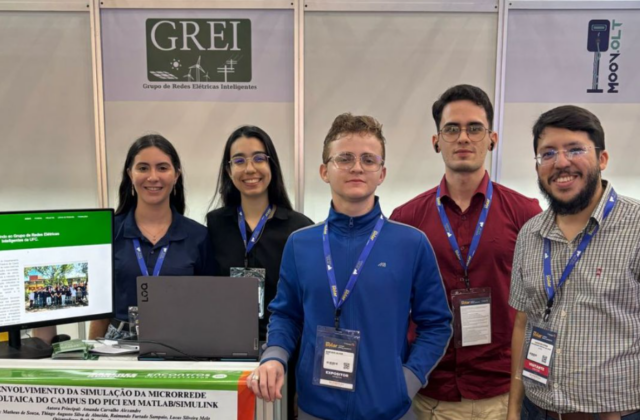
In the days that followed, May 9 and 10, the National Electrical Sector Circuit (CINASE) held its 30th edition, for the second time in the city of Fortaleza. The event featured a series of technical talks related to the electrical sector, covering topics such as power generation, transmission and distribution, distributed generation, measurement and testing equipment, automation, electrical equipment, high-voltage panels, and substations, among others. CINASE also featured an exhibition with booths from manufacturers and suppliers of electrical equipment with strong representation across the country — a moment for exchanging experiences and connecting suppliers, manufacturers, and engineers, in which GREI members also took part.