
Intersolar Summit is a series of specialized conferences and events focused on the photovoltaic solar energy sector, energy storage, and related solutions, held in different regions around the world. These events aim to promote knowledge exchange, discuss technological innovations, explore business opportunities, and address the regulatory and market challenges of the renewable energy sector.
The fifth edition of the event, held on April 23 and 24 at the Ceará Events Center in Fortaleza, closed with an expressive milestone: a historic attendance record, surpassing 5,000 visitors. The intense flow of participants through the 90 available booths firmly cements the event on Ceará’s business calendar and reinforces its relevance for the whole Northeast region, promoting debates that go beyond legal and regulatory challenges to also cover financing issues and solutions for the energy transition.
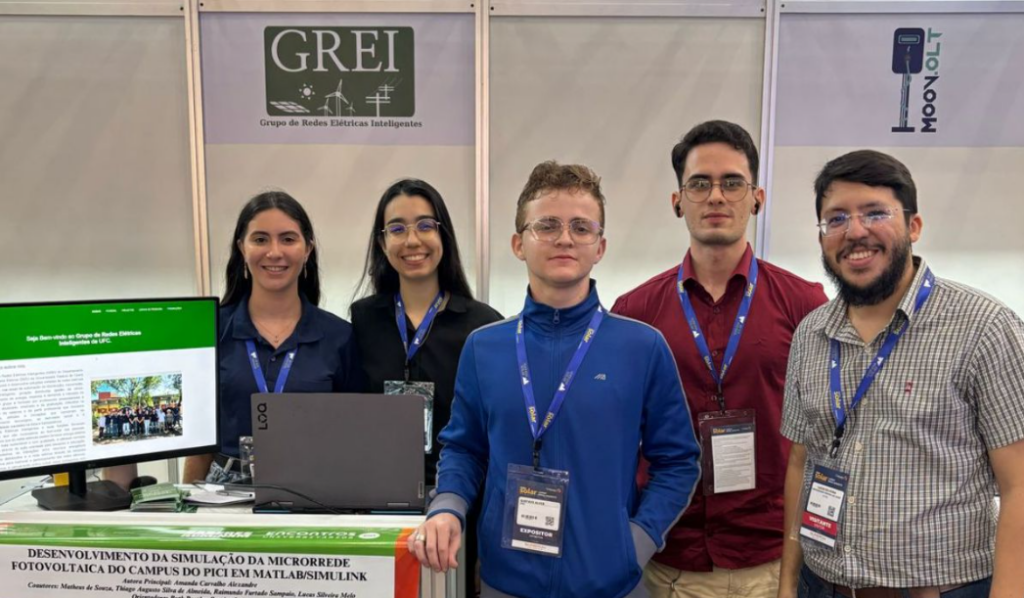
The Smart Electrical Grids Group (GREI) was invited to take part in the conference by the Innovation Hub of the Euvaldo Lodi Institute (IEL), an institution dedicated to connecting and preparing companies to develop market-oriented innovative solutions. GREI’s presence at the event aimed mainly to present a portfolio of innovative, technologically advanced projects developed by its researchers and students. Among the showcased initiatives, one of the lab’s major research tracks stood out: the virtualization of electrical plants, reflecting the group’s commitment to combining innovation, practical application, and academic excellence.
One of the highlights was the demonstration of the Virtual Reality Substation, an immersive tool that lets users visualize, interact with, and understand the inner workings of an electrical substation in a safe, highly realistic virtual environment. This technology not only makes it easier to learn complex engineering concepts, but also serves as a training platform for industry professionals, reducing operational risks and costs.
Another highly relevant project presented was the Virtual Reality Microgrid, which enables simulation and management of local and distributed energy systems. Through this platform, it’s possible to analyze microgrid behavior under different operating conditions, integrating renewable sources, storage systems, and energy loads. The application represents a significant step forward in preparing students and specialists for the challenges of operating modern, sustainable grids.
GREI also showcased progress on the simulation of the Pici Campus Photovoltaic Microgrid, modeled in the MATLAB/Simulink environment. This project aims to digitally replicate the real conditions of energy generation and consumption on the university campus, incorporating local data and specific parameters to create a precise, functional virtual laboratory. The initiative enables in-depth studies on solar energy integration, grid stability, and energy efficiency, contributing to both academic research and institutional energy management.
These projects reflect GREI’s commitment to quality education grounded in technological immersion and innovative practice. They not only expand training opportunities for students but also strengthen the link between the university and productive sectors, positioning the group as a regional and national reference in smart electrical grids and transformative education.